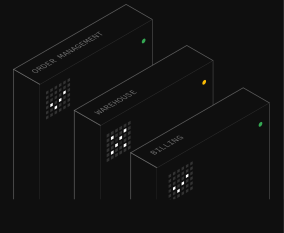
In distributed operations, completion in one system doesn't guarantee alignment everywhere. Vaurd ensures that what your business considers done is reflected consistently across every system it touches.
See how Vaurd works
Cross-System Consistency
Every system confirms the action. No alerts, no flags — just a silent disagreement that sits undetected until it breaks something.
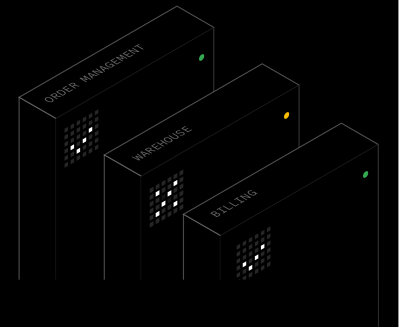
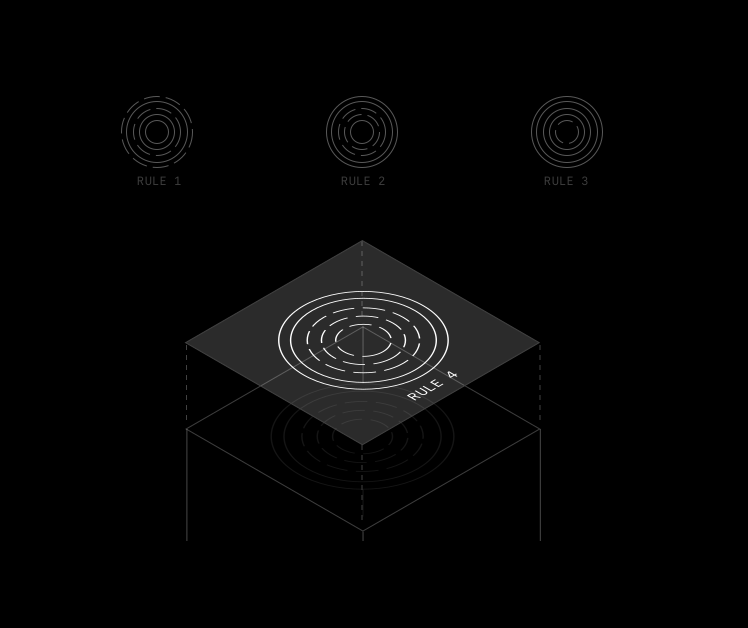
Define exactly what correct execution looks like and attach an automated response to every rule. Vaurd agents continuously verify your processes in real-time—if execution matches intent, nothing happens. If it deviates, the exact right team is alerted instantly.
2.0 SOLUTIONS
Not every mismatch carries the same weight. Define which systems must align, what states are considered equivalent, and how much delay is acceptable — consistency governed by your rules, not system assumptions.
Continuously verify that defined consistency holds across your systems — not through periodic manual checks, but the moment relevant activity occurs. A status update that propagated to three systems but silently failed in a fourth is caught immediately, before any downstream team acts on conflicting data.
The longer systems disagree, the more decisions get made on conflicting data. A mismatch that sits undetected for a week doesn't stay isolated — it flows into every report, every forecast, and every downstream action built on top of those systems before anyone realizes the source data was never aligned.
Remove the spreadsheets, cross-system queries, and periodic comparisons. The reconciliation exercise that used to take your team two days every month no longer holds the calendar — Vaurd tracks alignment continuously, so discrepancies never accumulate into a backlog that needs manual resolution.
Get shared visibility across your systems without introducing reconciliation platforms, orchestration layers, or custom sync services — no new dependencies, no additional complexity.
Start verifying consistency
Reports, forecasts, and strategies built on disagreeing systems look correct — until someone traces the numbers back to a source that was never actually aligned.
The cost of finding inconsistency late is always higher than catching it early. Rework compounds, trust erodes, and the longer divergence sits, the more decisions get built on top of it.
Manual reconciliation is a tax on your team that grows with every system added and every transaction processed. What fits in two days this quarter doesn't fit at all by next year.
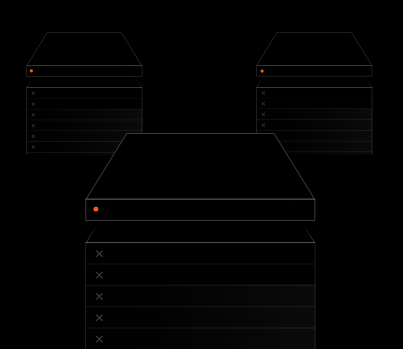
Divergence doesn't stay isolated. A mismatch in one system flows automatically into every dependent process — silently, structurally, until it surfaces somewhere expensive.